CitraZoy Zoysia
Fine-blade Zoysia with the tightest carpet of any cultivar we mow. Built for reel-cut finish — the cultivar Winter Park homeowners choose specifically for the showcase front-lawn read.
Tournament-grade precision cuts on the estate lawns between Park Avenue, Lake Virginia, and the Maitland boulevard. Every Winter Park reel mowing program Yard Works runs is owned by the turfgrass-certified specialist himself — sharpened reels, consistent stripe direction, and a cut height calibrated to your cultivar week after week.
Yard Works runs weekly reel mowing programs across Winter Park's most design-conscious neighborhoods — Windsong, Olde Winter Park, the Vias, Genius Drive, Temple Grove, Osceola Avenue, and the lakefront estates between Lake Virginia, Lake Maitland, and Lake Osceola. Every program is owned by Michael Geist, a turfgrass-certified Winter Park reel mowing operator who calibrates the cut to the cultivar, rather than running one mower height across every property on the route. Reel mowing in Winter Park is the right call when the lawn is a fine-blade Zoysia (CitraZoy, Trinity, Zeon, Empire, Diamond, or Emerald) or a Florida-common Bermuda (TifTuf, Celebration, Tifway 419) — the cultivars bred for low cut heights and a scissor-action finish. St. Augustine cultivars (Floratam, CitraBlue, Seville, ProVista) are not reel-mowed; we maintain those on a sharp rotary at the higher cut heights UF/IFAS specifies for the species.
A reel mower cuts grass with a scissor action between the spinning reel and a fixed bedknife. A rotary mower cuts by impact — a high-speed blade tearing through the leaf. On a fine-blade Zoysia or a Florida Bermuda lawn at half an inch to two inches of cut height, the difference is visible the first week: a reel-mowed lawn presents a uniform, low-sheen finish with crisp leaf tips, while a rotary cut shows a frayed, gray-tinted line of torn leaf edges that browns within 48 hours.
For Winter Park homeowners who chose a fine-blade Zoysia or a Florida-common Bermuda specifically for the estate-grade finish, reel mowing is what makes that finish read. Cleaner cuts also reduce disease entry points, support faster regrowth, and stimulate the lateral tillering and stolon density that build a tight, dense canopy.
Full Reel Mowing Services Overview →Reel mowing's value isn't aesthetic alone — it's a turf-health protocol. Cleaner cuts mean less stress per mowing event, which translates directly into more energy directed toward lateral growth: tillering in Zoysia and rhizome and stolon development in Bermuda. Over a Florida growing season, the difference compounds into a noticeably denser canopy.
The University of Florida IFAS Extension's Mowing Your Florida Lawn guidance (EDIS) sets cultivar-specific cut heights for warm-season turfgrasses. Fine-blade Zoysias such as CitraZoy, Trinity, and Zeon perform best between 1 and 2 inches; Empire Zoysia holds best at 1.5 to 2.5 inches; Diamond Zoysia is the one cultivar built for fairway and putting-surface heights at 0.5 to 1 inch; common-and-improved Bermudas (TifTuf, Celebration, Tifway 419) cut clean from roughly 0.5 to 1.5 inches. The right reel-mowing height for a Winter Park lawn is set to the cultivar — not to a one-size-fits-all standard.
The "one-third rule" is the constant: never remove more than one-third of the leaf blade in a single mowing event. Cutting beyond that threshold scalps the crown, exposes soil, invites weed pressure, and triggers a stress response that suppresses growth for days. A weekly reel-cut program calibrated to the cultivar is what keeps Winter Park Zoysia and Bermuda lawns inside that envelope from May through October.
Reel mowing is the right finish on fine-blade Zoysia and on Florida-common Bermuda cultivars — the warm-season grasses bred for low cut heights and dense, scissor-cut response. St. Augustine cultivars (Floratam, CitraBlue, Seville, ProVista) are not reel-mowed; we maintain those on a sharp rotary at the higher cut heights UF/IFAS specifies for the species.
Fine-blade Zoysia with the tightest carpet of any cultivar we mow. Built for reel-cut finish — the cultivar Winter Park homeowners choose specifically for the showcase front-lawn read.
Fine-blade Zoysia bred for tight, uniform appearance and Zone 9B cold tolerance. Reel mowing brings out the architectural finish Trinity was designed for.
The shade-tolerant Zoysia. Ultra-fine blade, soft underfoot, and an ideal reel-mow target on properties with partial oak canopy where the showcase finish is still the goal.
Medium-blade Zoysia with excellent wear recovery — our go-to for reel-mowed family lawns that want the Zoysia look at a slightly more forgiving cut height.
The fairway- and putting-grade Zoysia. Ultra-fine blade, shade-tolerant, and built for the lowest reel heights of any Zoysia we install. The right choice for showcase Winter Park front lawns where the surface needs to read like a green from the curb.
Classic fine-blade Zoysia — a Zoysia japonica × matrella hybrid with a dark-green color and dense canopy. A long-proven reel-mow performer in Central Florida and a reliable pick for properties that want fine-blade Zoysia without the price of the newer cultivars.
University of Georgia–bred fine-textured Bermuda with the strongest drought tolerance of any modern cultivar. Holds color through Florida summer stress, recovers fast from traffic, and finishes beautifully under a sharp reel.
Dark-blue-green Bermuda with exceptional density, wear recovery, and shade tolerance better than most Bermudas. A premium full-sun pick for Winter Park lawns that want a Bermuda finish under a reel program.
A reel-mow program is a weekly relationship, not a one-time service. This is the protocol every Yard Works Winter Park reel mowing route follows from the first cut through the dormancy hand-off in November.
Cultivar identified, cut height set per UF/IFAS guidance, stripe direction logged. The program is calibrated to your lawn before week one.
Reels and bedknives are sharpened and backlapped on a regular interval. A dull reel tears like a rotary — the entire program depends on a true edge.
Cut frequency is matched to growth rate so we never remove more than one-third of the leaf blade in a single visit — May–October weekly, off-season as needed.
Stripe direction rotates each visit to prevent leaning, ruts, and grain — and to keep the finish reading uniformly from any angle of the property.
Hardscape edges, irrigation heads, tree rings, and bed lines are trimmed by hand each visit. The reel cut only reads if the edges read with it.
Clippings are returned in most weeks (the UF/IFAS recommendation — clippings recycle nitrogen and break down quickly), bagged when accumulation or seedheads warrant it.
Reel-cut Winter Park lawns benefit from periodic topdressing with a fine sand or soil blend — we flag the window when surface variance, density, or thatch warrants it.
Cut height is raised entering dormancy and lowered as green-up returns. Written first-cut notes on the route every spring so the lawn enters the season at the right height.
Topdressing — a thin, even application of high-quality sand or a sand/compost blend across the lawn surface — pairs directly with a reel-mow program. On a Winter Park Zoysia or Bermuda lawn, topdressing smooths surface variance (the small undulations a reel mower would otherwise scalp), increases density by encouraging stolon, rhizome, and tiller contact with fresh soil, and improves water management at the rootzone. It also dilutes thatch buildup and accelerates recovery after aeration.
The cumulative effect over two or three seasons is a noticeably higher-end finish: the lawn presents flatter, denser, and more uniform under the reel — the look that distinguishes an estate-grade Winter Park lawn from an average suburban one. Topdressing is offered as a stand-alone service for Yard Works reel mowing clients, or programmed annually for properties on a year-round maintenance plan.
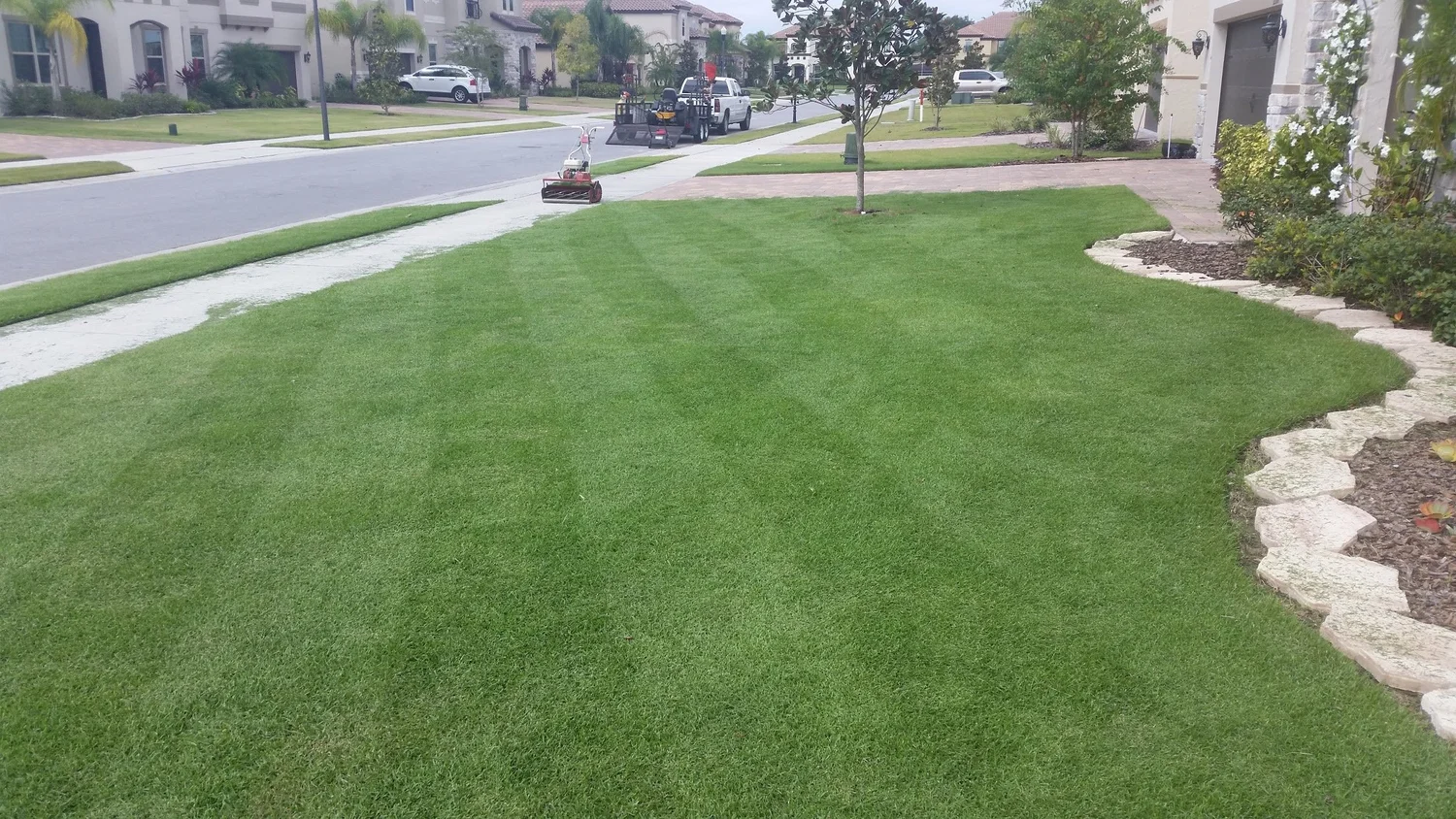
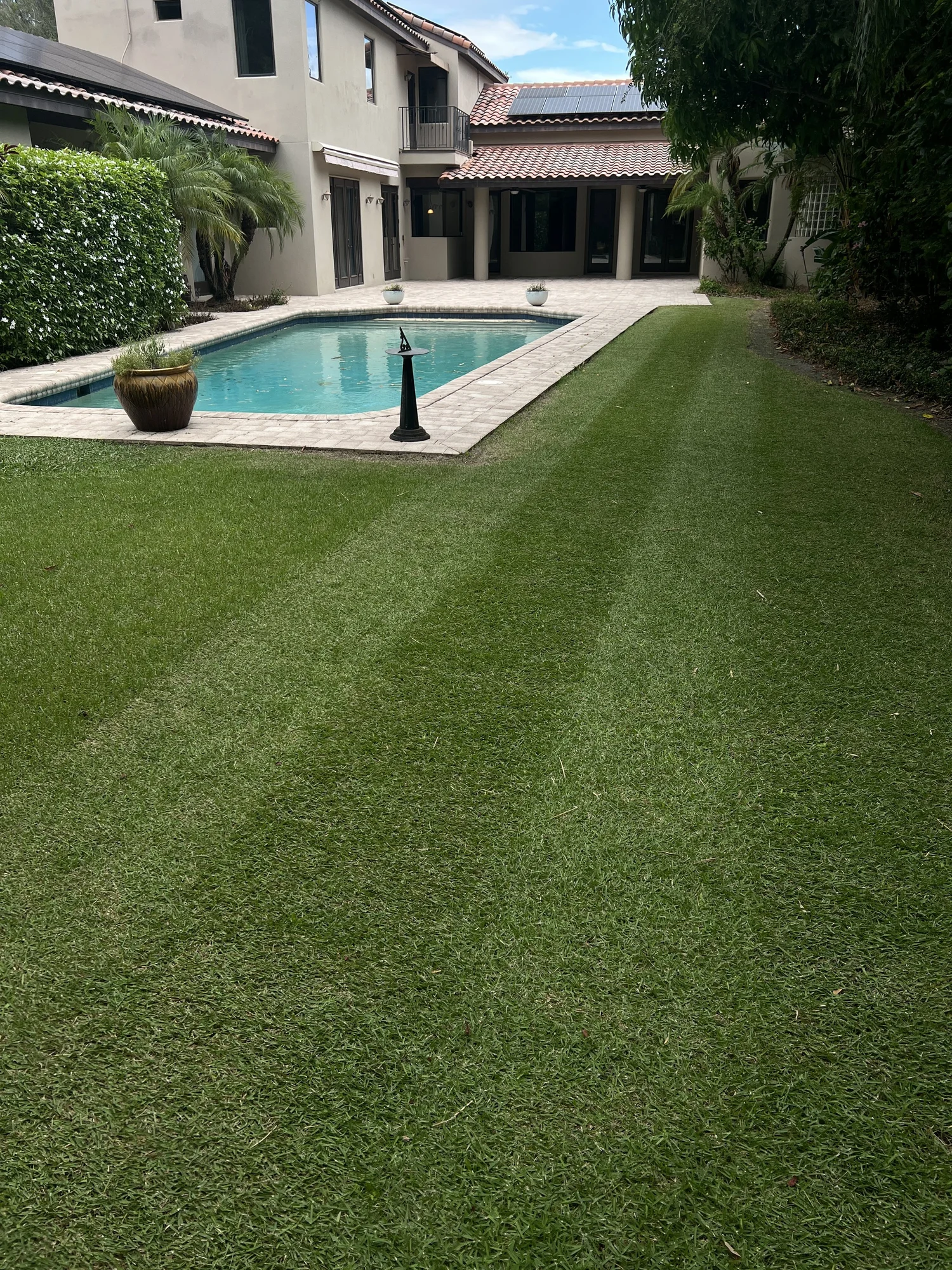
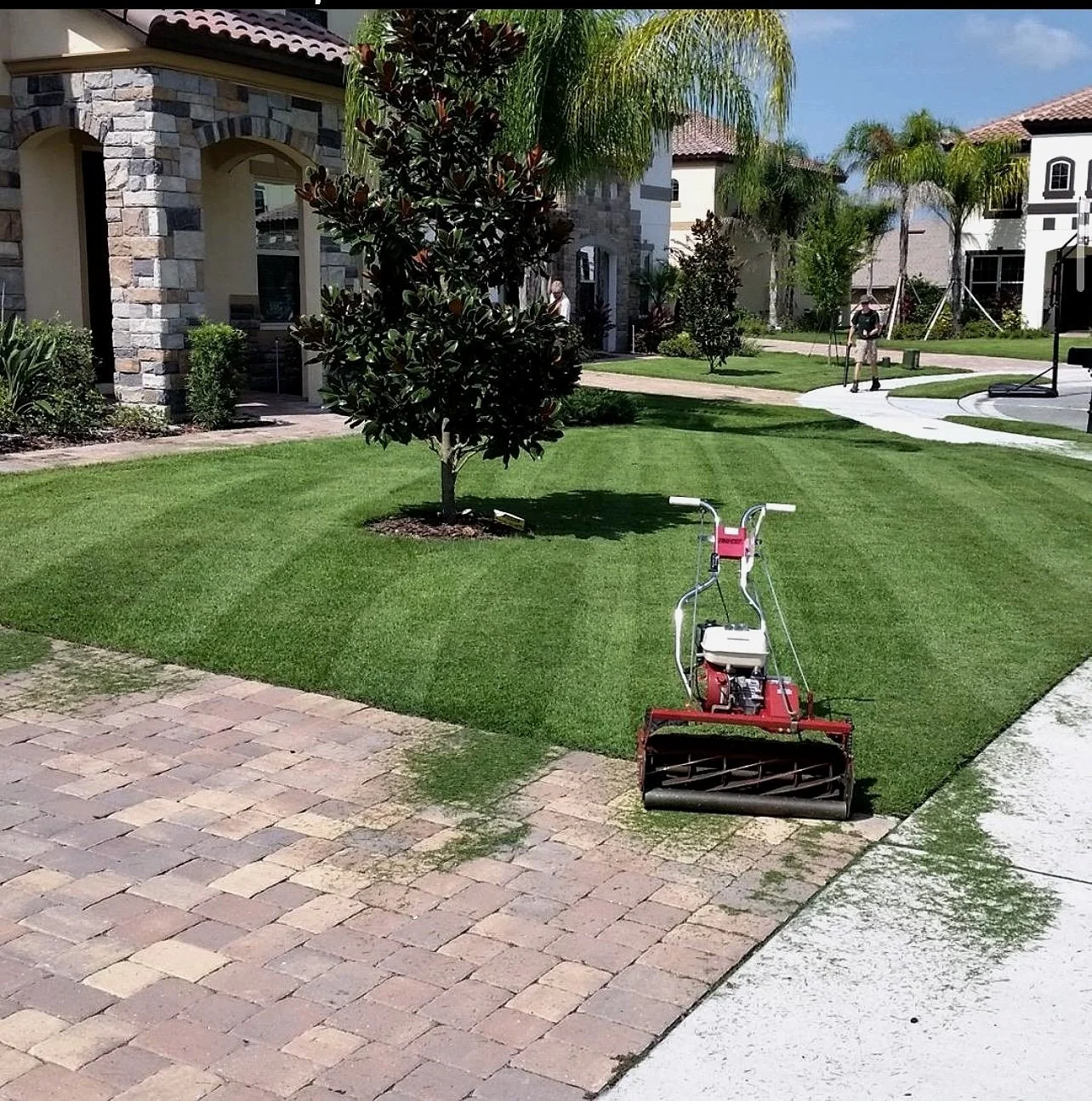
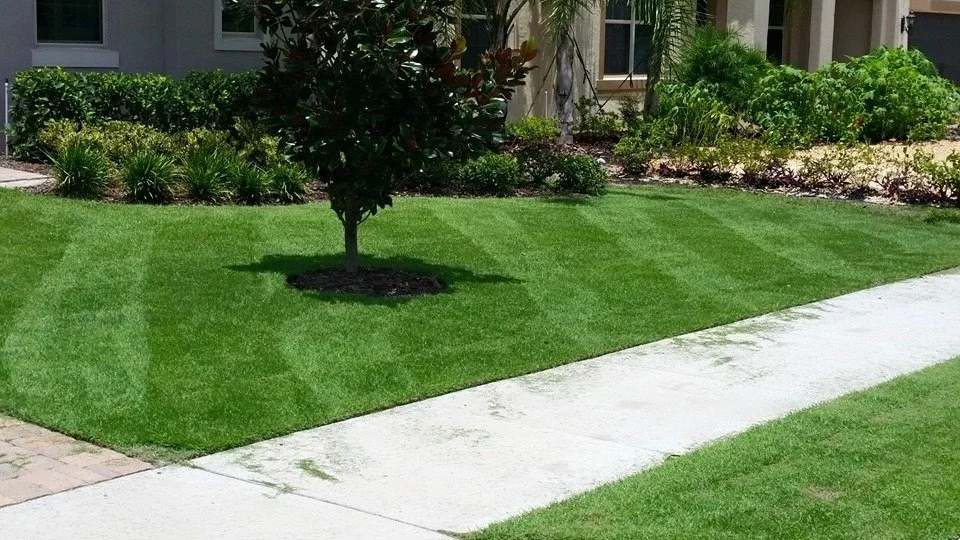
Ongoing Winter Park Lawn Maintenance →Every image is from an actual Yard Works route. Sharpened reels, calibrated cut heights, weekly stripe rotation — this is what an estate-grade reel-mow program looks like across Central Florida.
Yard Works runs owner-operated reel mowing programs across Winter Park and the broader Seminole and Orange County market. Below are the silo-sibling service pages — the current Winter Park reel mowing page is marked.
Windsong · Olde Winter Park · The Vias · Genius Drive · Temple Grove · Osceola Avenue · Lake Virginia · Lake Maitland.
Alafaya Woods · Carillon · Kingsbridge · home base for the Yard Works crew.
Maitland boulevard estate corridor · Lake Lily · Dommerich Hills.
Tuscawilla · Parkstone · Howell Creek estate lots.
Heathrow · Markham Woods · Timacuan estate neighborhoods.
Baldwin Park architecturally-consistent lots and front-lawn reveal corridors.
A reel mower cuts grass with a scissor action between a spinning reel of curved blades and a fixed bedknife. A rotary mower cuts by impact — a high-speed blade tearing through the leaf. The reel-cut leaf heals faster, browns less, and keeps a uniform low-sheen finish on fine-blade Zoysia and Florida-common Bermuda lawns. On a Winter Park lawn at half an inch to two inches of cut height, the difference is visible from the curb the first week.
Reel mowing rewards the cultivars Winter Park homeowners typically choose for the estate-grade finish — fine-blade Zoysias such as CitraZoy, Trinity, Zeon, Empire, Diamond, and Emerald, and Florida-common Bermudas such as TifTuf, Celebration, and Tifway 419. The cleaner cut reduces disease entry points, supports faster regrowth, stimulates the lateral tillering and rhizome density that build a tight canopy, and produces the consistent stripe presentation that reads from Park Avenue and the lakefront approaches. It is also the right tool for the lower cut heights these cultivars are bred for: a rotary cannot finish a Zoysia or Bermuda at half an inch to one inch without scalping.
Winter Park reel mowing is priced per visit and depends on lawn size, cultivar, edging scope, and access. Most residential reel-mow programs in Winter Park are tailored to lawn size, cultivar, and scope, with full-program estimates always delivered on-site. A program includes the reel cut, hand-edging at hardscape and beds, irrigation-head trim, and clipping management — not just the mow line. Free, on-site estimates for every Winter Park reel mowing program.
Reel mowing is right for fine-blade Zoysia (CitraZoy, Trinity, Zeon, Empire, Diamond, Emerald) and for Florida-common Bermuda cultivars (TifTuf, Celebration, Tifway 419) — the warm-season grasses bred for low cut heights and dense canopies. St. Augustine cultivars (Floratam, CitraBlue, Seville, ProVista) are not reel-mowed at Yard Works; we maintain those on a sharp rotary at 3 to 4 inches per UF/IFAS guidance. Yard Works will tell you on the site walk which finish is right for your lawn — and we run rotary programs in Winter Park as well.
From May through October, a Winter Park reel-mow program is weekly. The "one-third rule" is the constant: never remove more than one-third of the leaf blade in a single mowing event. Skipping a week in growth season frequently means the next cut violates that rule, scalps the crown, and resets the lawn. From November through April, frequency drops with growth rate — every two to three weeks is typical for warm-season turf in Zone 9B.
Yes. Yard Works runs reel mowing programs across Windsong, Olde Winter Park, the Vias, Genius Drive, Temple Grove, Osceola Avenue, Baldwin Park, and the lakefront estates between Lake Virginia and Lake Maitland. Licensed and insured, owner-operated, and HOA-walkthrough compliant in every Winter Park community we serve.
Topdressing — a thin, even layer of fine sand or sand/compost blend — smooths the surface variance that a reel mower would otherwise scalp, increases canopy density by encouraging stolon and tiller contact with fresh soil, dilutes thatch, and improves water management at the rootzone. The cumulative effect over two or three seasons is a flatter, denser, more uniform reel-cut finish — the look that distinguishes an estate-grade Winter Park lawn. Available as a stand-alone service or programmed annually.
Yard Works is licensed and insured across Seminole and Orange County. Owner Michael Geist is turfgrass certified for warm-season and cool-season cultivars, sports field management certified, and has been maintaining Central Florida lawns since 2005. Insurance certificates are available for HOA submission on request.
Every Winter Park reel mowing program starts with a direct conversation with Michael Geist — the turfgrass-certified owner who will walk the property, identify the cultivar, set the cut-height program, and be on your driveway the day the route runs. No call centers, no handoffs, no surprises. Free, on-site estimates for weekly reel mowing, topdressing, and full estate lawn programs across Winter Park.
Every service engineered for Central Florida's Zone 9b climate

